
Inside Newark Airport’s Ongoing Disruptions and the Real Outlook for 2026
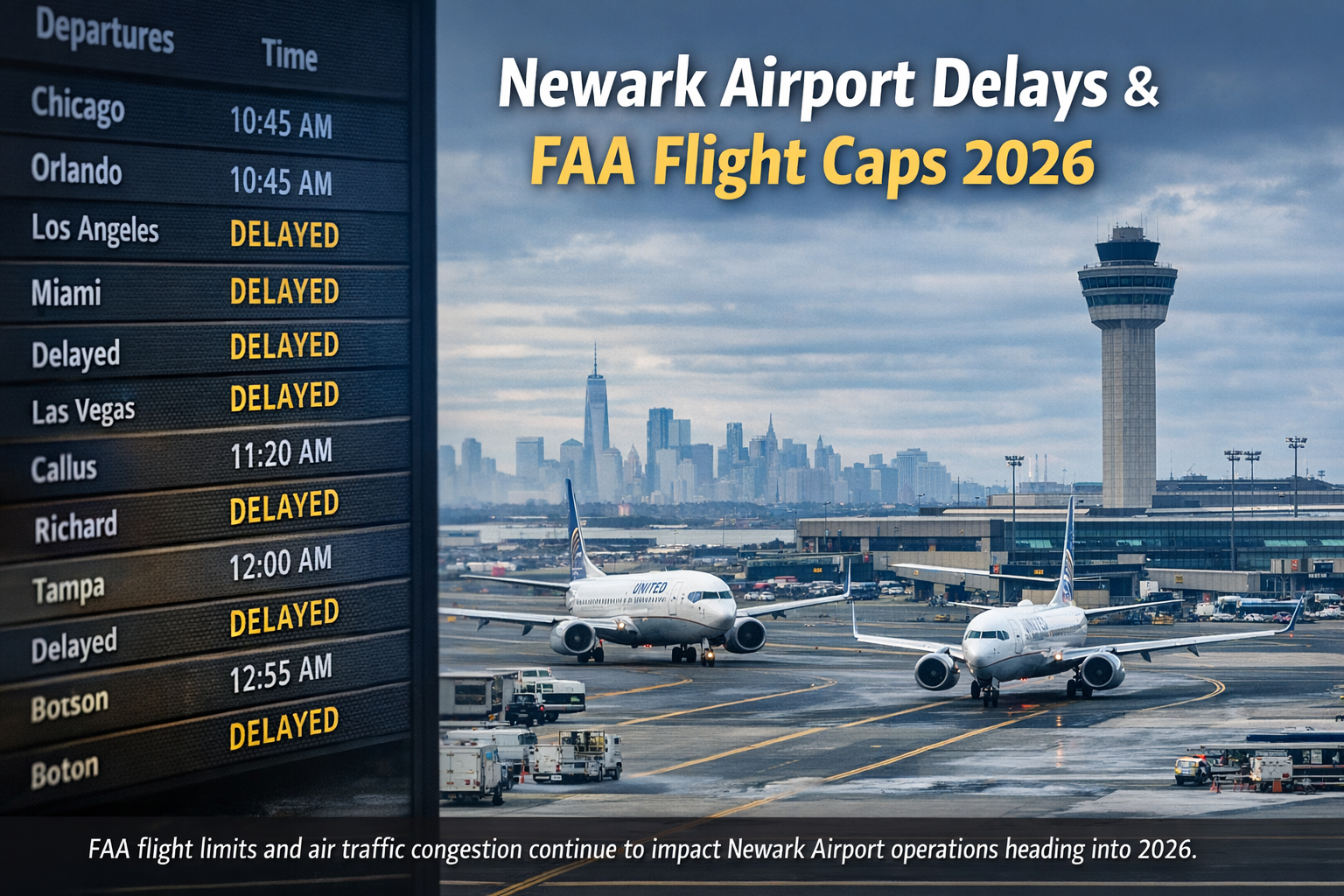
Newark Airport Under Pressure: What’s Really Happening Now — and What Travelers Can Expect in 2026
Why Newark Liberty International Airport Continues to Face Disruptions — and Whether Meaningful Relief Is Coming
Anyone who has traveled through Newark Liberty International Airport (EWR) in recent months has likely noticed the same pattern: departure boards filled with delays, gate changes announced with little warning, and vague “air traffic control” explanations that somehow derail an entire day of travel.
For many passengers, this feels like random chaos or seasonal bad luck. In reality, Newark’s challenges are rooted in deeper structural issues. The airport sits at the center of one of the most congested airspaces in the world and operates under a complex mix of Federal Aviation Administration (FAA) restrictions, controller staffing limitations, aging infrastructure, and persistent Northeast weather volatility.
While headlines often focus on isolated incidents, the truth is that Newark’s disruptions follow predictable patterns. There is also a real — though gradual — path toward improvement. The key question is whether travelers will feel that improvement in 2026, or whether the fixes remain largely behind the scenes.
This guide explains what’s happening at Newark, why problems escalate so quickly, what “relief” realistically means in 2026, and how travelers can reduce risk while the system continues to adapt.
Newark’s Challenge in Plain Language
Newark is operating in an environment where more flights are scheduled than the surrounding airspace can consistently support. To keep operations safe and manageable, the FAA has repeatedly slowed or capped traffic, which prevents complete gridlock but also creates ongoing delays.
This isn’t unique to Newark — but because of its location and volume, EWR feels the effects faster and more severely than many other U.S. airports.
FAA flight limits and air traffic congestion continue to impact Newark Airport operations heading into 2026.
Why Newark Delays Escalate Instead of Recovering
1. FAA Operating Limits Remain in Place Through Late 2026
In response to repeated congestion and safety concerns, the FAA introduced operational limits at Newark in 2025. These restrictions were later extended through October 24, 2026. Although the FAA modestly increased the hourly flight cap compared to earlier limits, traffic levels remain below pre-cap volumes.
The reasoning is straightforward: the regional airspace and supporting infrastructure cannot safely handle previous traffic levels without triggering severe delays and cascading failures.
For travelers, this means Newark operates with minimal flexibility. On calm days, the system may appear stable. But when weather disruptions, staffing shortages, or technical problems arise, delays compound rapidly because there is little buffer built into the schedule.
2. Newark’s Performance Depends on Regional Air Traffic Control Health
Newark’s operations are closely tied to the air traffic control facilities that manage arrivals and departures throughout the region. The FAA has cited staffing and technology challenges affecting these approach control centers, along with ongoing runway construction, as recurring stress factors.
Put simply: Newark does not operate in isolation. If regional control facilities are strained, Newark’s performance declines almost immediately. This tight coupling is one reason delays spread so quickly.
3. Controller Staffing Shortages Are a National Constraint
Air traffic controller staffing shortages are not limited to Newark. The FAA has openly acknowledged nationwide staffing gaps and has stated that when staffing falls below required levels, traffic must be slowed to maintain safety.
Numerous aviation and national news outlets have documented how staffing-related flow controls can trigger ground delays and system-wide disruptions. Newark, given its volume and location, is often one of the first airports affected.
4. Aging Technology Adds Fragility to the System
Modern aviation relies on an extensive digital backbone. When that backbone is outdated, the margin for error shrinks. Following several high-profile outages and disruptions, the FAA announced a $6 billion modernization investment to upgrade air traffic control telecommunications and radar systems, with deployment planned through 2028.
This matters enormously for Newark. At EWR, even a brief technical disruption doesn’t stay local — it can ripple across the entire Northeast corridor, impacting multiple airports and airline networks simultaneously.
What “Improvement in 2026” Actually Means
Discussions about relief often blend together different timelines. Understanding the distinction matters.
Near-Term Reality: Newark-Specific Flight Restrictions
The FAA’s operational limits at Newark extend into late 2026. This signals that congestion and capacity constraints are expected to remain part of Newark’s daily reality throughout the year.
This does not mean conditions won’t improve at all. It means Newark is unlikely to return to unrestricted scheduling without recreating the same delay spiral that led to these controls in the first place.
Mid-Term Outlook: National Airspace Modernization
The FAA’s broader modernization effort targets deployment through 2028. While progress will continue in the meantime, the most transformative infrastructure upgrades are expected to arrive gradually rather than all at once.
What this means for travelers:
-
2026 could feel more stable if flight caps prevent chronic overload and staffing improves
-
The most meaningful resilience improvements are more likely in 2027–2028
The Recurring “Meltdown Cycle” at Newark
Despite appearing unpredictable, Newark disruptions often follow a familiar pattern:
-
A trigger event occurs — weather, staffing shortages, runway work, or a technical issue
-
The FAA initiates traffic flow management, slowing arrivals, spacing aircraft, or issuing ground delays
-
Travelers can track real-time impacts via FAA delay programs at fly.faa.gov
-
-
Airlines scramble to protect their networks as aircraft and crews fall out of position
-
Delays propagate beyond Newark as those same planes and crews are scheduled elsewhere later in the day
This explains why a modest delay early in the day can turn into a cancellation by evening. The system manages interconnected networks, not isolated flights.
Business travelers frequently rely on a professional Newark Airport car service to maintain schedule flexibility during FAA-related disruptions
Why Winter Weather Amplifies Disruptions
Winter travel issues at Newark extend far beyond snow on the runway.
Storms across the Northeast often cause:
-
Reduced arrival rates across multiple airports
-
Regional ground stops and traffic flow restrictions
-
Aircraft and crew displacement throughout airline systems
Key Causes of Newark Delays — and How Travelers Can Respond
| Delay Factor | What Travelers See | Why It Happens | How to Reduce Risk |
|---|---|---|---|
| FAA flight caps | Persistent ATC delays | Operating limits through late 2026 | Fly early, build buffer time |
| Controller staffing | Intermittent slowdowns | Safety-driven traffic throttling | Choose nonstop flights |
| Runway construction | Taxi and gate delays | Temporary capacity reduction | Avoid peak banks |
| Technology issues | Sudden schedule resets | Aging systems under upgrade | Monitor FAA flow programs |
| Winter storms | Rolling cancellations | Regional airspace interdependence | Travel earlier or a day ahead |
Practical Strategies for Flying Through Newark
1. Depart Early in the Day
Morning flights are far less exposed to upstream aircraft delays, crew timeouts, and gate congestion. If there’s one rule to follow at Newark, this is it.
2. Choose Nonstop Flights Whenever Possible
Connections amplify risk. A single delay on the first leg can unravel an entire itinerary.
3. Avoid Tight Connections
Newark delays tend to come in waves. Building realistic connection times can mean the difference between inconvenience and cancellation.
4. Use FAA Tools — Not Just Airline Apps
Airline apps show your flight status. FAA tools reveal whether the airspace itself is constrained. Travelers are encouraged to monitor conditions via fly.faa.gov.
5. Consider Alternate Airports for Critical Travel
For trips you cannot miss, flexibility matters. Nearby airports, earlier departures, or traveling a day ahead can significantly reduce risk.
Newark vs JFK vs LaGuardia: Which Makes Sense in 2026?
For travelers in the New York–New Jersey region, airport choice has become a risk-management decision.
-
Newark (EWR) remains essential for United hubs, international routes, and New Jersey access
-
LaGuardia Airport (LGA) often performs better for short-haul domestic travel due to controlled operations and shorter taxi times
-
John F. Kennedy International Airport (JFK), despite its size, can be more reliable for long-haul international departures, especially earlier in the day
In 2026, proximity alone is no longer the deciding factor — resilience is.
Best and Worst Times to Fly Newark in 2026
Lower-risk windows:
-
First departures before 9:00 AM
-
Late morning to early afternoon
-
Tuesdays and Wednesdays (non-holiday)
Higher-risk periods:
-
Late afternoon and evening
-
Sundays and Monday mornings
-
Days surrounding regional weather events
Experienced travelers are adjusting schedules — not just airlines — to minimize exposure.
Understanding FAA Flight Caps (Without the Jargon)
FAA flight caps limit how many aircraft can safely arrive and depart per hour. These limits are not punitive — they are designed to prevent system overload when staffing, weather, or infrastructure cannot support full schedules.
In 2026, these caps are expected to remain in place, even though throughput has increased slightly compared to earlier restrictions. This explains why Newark can feel slow even on clear days: the system is intentionally operating below its breaking point.
So… Is Meaningful Relief Coming in 2026?
What could improve:
-
Greater operational stability
-
Reduced throttling if staffing improves
-
Airline schedules better aligned with reality
What won’t be fully resolved:
-
Complete modernization of air traffic control systems, which extends through 2028
Final Perspective: Stability Over Perfection
Newark Liberty International Airport is not failing — it is operating under intentional restraint in one of the most congested airspaces in the world. Many delays travelers experience are the result of controlled slowdowns designed to prevent complete system breakdown.
Relief in 2026 is possible, but it won’t look like a sudden return to the past. Progress will come through more predictable operations, fewer cascading disruptions, and airlines adapting schedules to match what the airspace can realistically support.
Travelers who plan ahead — flying early, choosing nonstops, building buffer time, and monitoring FAA flow restrictions — will find Newark far more manageable.
By K and G Limousine
Providing professional airport transfers, executive black car service, wedding and prom limousines, cruise terminal transportation, casino trips, and luxury travel across New York, Long Island ,New Jersey, Connecticut, and surrounding areas.
RECENT POSTS
categories
- Uncategorized
- Governors Ball 2025
- FIFA Club World Cup 2025
- Sports events
- Limo service
- Prom Limo
- Transportation
- Baldwin NY
- Madison Square Garden
- New York Knicks vs. Detroit Pistons
- Events
- Long island
- Mineola Prom Limo Service
- Mineola NY
- Travel Tips for Europeans
- Luxury Travel
- Chauffeur Services
- International Travel Guides
- New York Yankees
- K and G Limousine
- Yankees Game Transportation
- Long Island Wine Tour
- jfk airport limo
- Airport Travel Updates